


Wide release date: August 13, 2025
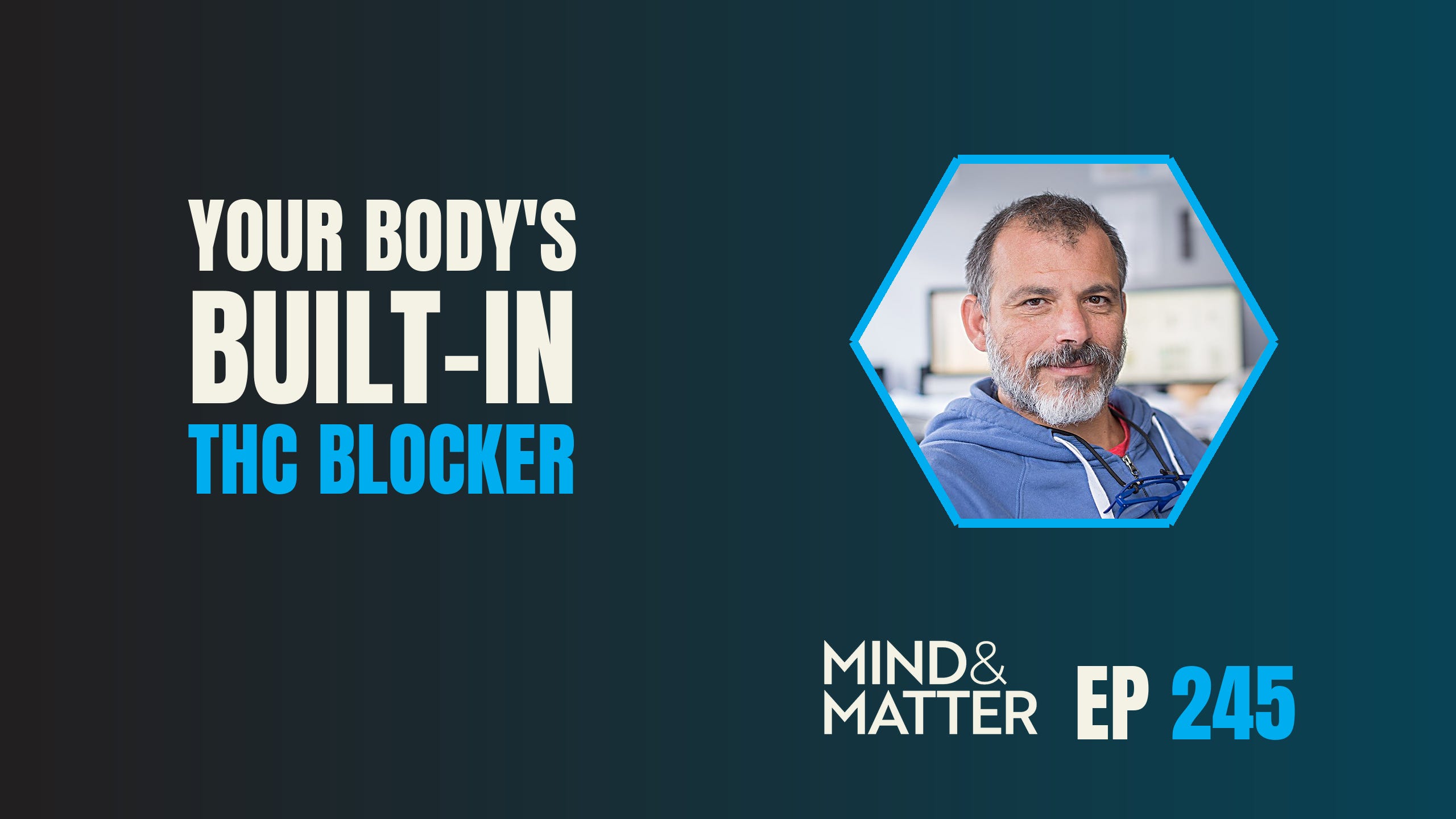
Episode Summary: Dr. Giovanni Marsicano is a neuroscientist based in Bordeaux, France, where he leads a research group at INSERM focusing on the endocannabinoid system.
About the guest: Giovanni Marsicano, PhD discusses the endocannabinoid system, starting with its core components like CB1 receptors and lipid-based molecules such as anandamide and 2-AG, derived from omega-6 fatty acids; he explains its cellular signaling, evolutionary role in energy storage for uncertain futures (exostasis vs. homeostasis), and effects across tissues like the liver, gut, and brain, including motivation, appetite, pain relief, and anxiety regulation, while touching on biphasic effects of cannabinoids.
Discussion Points:
The endocannabinoid system acts as an "exostatic" regulator, promoting energy accumulation for future needs by enhancing food palatability, nutrient absorption, and fat storage, unlike "endostatic" systems that address immediate hunger.
CB1 receptors appear in vertebrates with adipose tissue, suggesting an evolutionary link to storing fat for survival in unstable environments.
Endocannabinoids are lipids from omega-6 fats; high intake boosts their levels, potentially fueling obesity by creating a self-perpetuating cycle of overeating.
Activation of CB1 can have biphasic effects (e.g., low doses reduce anxiety, high doses increase it), due to receptors on different cell types like excitatory vs. inhibitory neurons.
Pregnenolone, a steroid precursor, acts as a natural CB1 inhibitor to prevent excessive activation, blocking harmful effects like psychosis from high THC doses.
The system influences motivation beyond food, including sex and even human activities like sports or storytelling, by rewarding actions for potential future benefits.
In the brain, CB1 on mitochondria and astrocytes modulates energy use, olfaction, and social stress transmission, with implications for disorders like Alzheimer's.
Reference Paper:
Related episode:
M&M 123: Endocannabinoids, Stress, Exercise, Cortisol, Anxiety, Cannabis & Effects of Marijuana on Brain Development | Matthew Hill
*Not medical advice.
Full video version: [YouTube]
Support M&M if you find value in this content.
Episode transcript below.
Episode Chapters:
00:00:00 Intro
00:05:01 CB1 Receptor Overview
00:10:58 Endocannabinoids & Lipids
00:16:00 CB1 as GPCR
00:21:04 Mitochondrial Signaling
00:26:09 Biphasic Effects
00:31:13 Homeostasis & Energy
00:37:40 Unstable Environments
00:43:59 ECS as Exostatic
00:50:13 Cue-Induced Feeding
00:55:00 Gut & Glucose Effects
01:00:32 Omega-6 Link
01:07:02 Pregnenolone Inhibitor
01:12:05 Modulation Mechanisms
01:17:03 Clinical Applications
01:22:15 Exostatic Coordination
01:26:19 Rewards Beyond Food
01:31:39 Cultural Motivations
01:36:43 Current Lab Work
01:42:12 Final Thoughts
Full AI-generated transcript below. Beware of typos & mistranslations!
Giovanni Marsicano 1:37
So I am in Bordeaux, France. And I am a neuroscientist. I work since many, many years and more than 25 years on a particular system that is the endocannabinoid system. And so the idea in my background is that I am a vet of education, a veterinary doctor. But then I didn't want to do the profession I liked the lab, and therefore I tried to do different things in related to, still to veterinary and then when I was 30 years old, I said, Okay, I need something that I really like. And I found PhD position. So I started my PhD very late. I was already 30 years old and and it was in Germany with Dr bet Lutz, who started the lab and who wants to use genetics to study learning and memory. And I proposed to him to study this was 97 so it was long time ago, and I proposed him to study endocannabinoid system in that in a moment in which the system CBR receptors started to be very, very famous, but it was Not yet very well, not much was known already. And since then I what I got in love with this system and and I say that, what I say always is that it is a kind of as I wrote with, together with a friend that is JD Baines in Canada, we wrote and are now Garcia in Spain. We wrote a review sometimes ago that was about the title. The idea was of Jaideep. But when the cannabinoid system extracting specificity from ubiquity, that means the system the receptor is expressed a bit everywhere, not really everywhere, but many places. But the system, instead the action of a system. And we will go a little bit more into details of the elements of the system, but seems to work in a very specific, specific way. And this kind of way, really, how you extract specificity from ubiquity is a general rule of the brain somehow, because we have four few elements, and with this, you feel the elements the brain and the body, are doing enormous, complicated things. And so what I say always is that our CB one receptors, basically, are our way to try to penetrate a bit the complexity of a brain. So we, instead of having a top down approach, in which we study a function, and we go to the molecules. We try to have bottom up approach. We start from one molecule, and we follow it into the brain where it is leading us, and to try to understand what could be general mechanisms, general properties of the brain, working. Oh. The brain and the body.
Nick Jikomes 5:01
Yeah. So, I mean, one of the things we'll talk about is the CB one receptor and some of the other pieces of the endocannabinoid system. But conceptually, you know, one of the things that we're going to dance around here is the CB one receptors in the brain. It's in the body, it's in all sorts of tissues, in many, many parts of the body. And one way you could start to think about it is okay, well, the receptor is doing something in liver cells, and it's doing something different in brain cells. And it's like, you know, you could think about it sort of one system or one tissue at a time, or you could think about it holistically and ask the question, is there sort of one sort of core function that's being coordinated through the system at the organismal level, or is this just sort of like a patchwork? It's just a type of receptor that any cell might use, but it's being used sort of in a different, different way, in different tissues. And we'll come to that. Let's give people a sense for the core elements of the endogenous cannabinoid system, starting with the receptor, I think what is the CB one receptor, and what does it do at the cellular level?
Giovanni Marsicano 6:05
So historically, as the namesake endocannabinoid system, has been identified as the target of cannabinoids. Cannabinoids are the chemical component of a plant, cannabis and marijuana and and we know since many 1000s years that this plant can have effect on the body. We don't, we don't know, of course, we didn't know, of course, until, let's say, middle of last century, how the plant was doing this. And at that time, two chemists, one in the states in the 40s, and then in Israel in the 60s, they identified the structure of these molecules that are called cannabinoids. And now we know that there are 100 compounds in the plant that we don't know the biological function of most of them, a large majority of them are unknown and but we know that there is one component that is very responsible of what the plant is doing at the level of psychotropic level, so that it's giving the High. And this is the famous Delta 90 trader cannabinoid, which 20 years later, 25 years later, was identified as a ligand of a specific receptor in the brain. And this was cloned at the end of 80s, and the paper was published in 1990 of a cloning of a receptor, and was called CB one, cannabinoid receptor one. And this CB one, the fact that it was already at the time necessary to put a one means that they knew already, somehow that there was something else. And three years later, I think 93 yes, they cloned a second receptors that is called CB two, which is more expressed in the periphery. It is much more mysterious at the moment than CB one and and it is very interesting, but we work on only on CB one. So once we had the receptor CB one, and we knew that CB one was responsive and CB two were responsive to the exogenous ligand. The question, of course, was why we have a receptor. It is not only to enjoy the THC somehow, but the evolution, or whatever will give us the receptor, because probably there are physiological functions. And to have a physiological function of a receptor, you need something that it is activating it. So very few years there after the cloning of receptor, again, the group of Raphael Metro in Israel, they identified endogenous ligands that are lipids, that are called endocannabinoids, that can activate the receptor in a similar, not identical, but in a similar way as THC does. And so at this point that it was clear that there was an endocannabinoid system in the brain that is formed by the cannabinoid receptors, CB ones we do. There is discussion about, what are the limits and what is, what are the boundaries of a system? Because if you find that there is that an endocannabinoid can activate also another receptor is this other receptor member of endocannabinoid system. This is a debate. This is a discussion. It's more formal and semantic. For me, I would stay more on the cannabinoid receptors and the ligands that are we call, so called endocannabinoids, that are lipids, most of most of them, and then all the machinery that is in when. Machinery that is involved in the synthesis degradation of endocannabinoids, and all the molecules that can bind to the receptor could be considered and activate or inhibit receptor could be considered as endocannabinoids. We have two endocannabinoids that are the most famous, two AG, to arachidonic glycerol and anandamide that are both derived from arachidonic acid. But we know that there are more molecules that can activate, or can, for example, allosterically, endogenously, allosterically regulate relativity versus so these are the elements. What the minimal core, minimal core of endocannabinoid system is receptors, ligands and machinery to meta, to synthesize and degrade. Yeah.
Nick Jikomes 10:58
So there's this core to the endocannabinoid system, there's two major receptors, CB one and CB two. There's two major endogenous cannabinoids, Ananda, mind and two, AG, they're both lipid derived, fatty activators of the CB receptors. And there's also the enzymatic machinery that regulates the turnover of these molecules and how long they're active. There's more to it than that, right? These molecules combine other receptors, and there's, you know, we we can, you know, get into the semantics of whether or not we consider those things part of the endocannabinoid system. But for our purposes today, we'll probably mostly focus on the CB one receptor, which was the first one discovered. Even though it's not the only one, it's in the brain and it's in the body, it interacts with both of the endogenous cannabinoids as well as THC. And you know, there's more to the story than that. Maybe we'll get into far and some of the other enzymes, but for our purposes, today, we'll be talking mostly about CB one receptor interactions. So you mentioned that that endogenous cannabinoids are lipids. Can you say a little bit more about that? How are they actually generated from fats in the body, and how do they connect to the Omega six polyunsaturated fatty acid precursors that that we think about oftentimes in the context of diet,
Giovanni Marsicano 12:08
yes, but production of endocannabinoids in in the brain is a sorry in the cells of The body is very complete, complex and redundant, let's say, perhaps, couple of biochemical pathways that have been identified. But then we realized that people, the biochemists that were studying these aspects, realized very soon that there are different ways through which endocannabinoids can be produced or degraded. But let's say, on, on a, on, to keep, to keep it relatively simple, let's say that we have on one, one end, we have an undermide that is produced by an enzyme that is called nape, PLD and seal Po, I
Nick Jikomes 13:05
don't remember big, long
Giovanni Marsicano 13:09
phospholipes D, which is producing, finally, will lead to the production of endocannabinoids. And on the other hand, you have a torachidanicly that is derived from, also from arachidonic acid through enzymes, the Doug lipase, so the D, D acyl glycerol lipase, which means that removes a chain. Yeah. Well, I mean,
Nick Jikomes 13:44
one thing I want to say, one thing I want to say here for people is, on the one hand, we don't want to get buried in some of the arcane nomenclature here, but if you listen to some of these words, so we'll use a lot of abbreviations, like two, AG, two, arachidona, glycerol, glycerol, sort of like the glycerol backbone of a triglyceride lipase, an enzyme that breaks down lipids. They all have these big, long names, but the reason that they have names like this is because of their lipid nature. And so that's just sort of a nomenclature thing I'll say up front. And
Giovanni Marsicano 14:17
what what you were mentioning before, they are directly linked to the diet, type of type of of lipids that are all the all the lipids that can be can turn somehow into their achidonic Acid Cycle. All bees are amenable to produce to increase endocrine Yeah. And
Nick Jikomes 14:40
so ultimately, this would be omega six polyunsaturated fatty acids, right? So when we, when we eat things like seed oils that have linoleic acid, these can be elongated into arachidonic acid, and then that's sort of like the precursor to a lot of different things, but including the the endocannabinoids,
Giovanni Marsicano 14:56
yes, yes. Then there is a link, for example, with. Between the endocannabinoids and prostaglandins and and so to AG is also in the pathway of of catabolism of prostaglandins. So there is a relationship between inflammation and endocannabinoid levels and so on. So the thing is, is very complicated. Let's say that, from the side of endocannabinoid is the most complicated CB one we can play around. We can, we can we have one molecules hyper complicated. But if we go to see the, all the how the lipids can be, lipids are the most difficult thing to study in theology, because they're
Nick Jikomes 15:41
ephemeral. They're constantly changing and turning into we cannot
Giovanni Marsicano 15:45
see them. There is no way to label them that you label a David already. You change everything. So it's, it's, it's, it's, they are very often neglected, right? They're not important because they are a mess.
Nick Jikomes 16:00
Yeah, I mean, a part of what you said there is they're experimentally almost intractable, because being able to watch them move and track them requires you to change them. But due to the sort of fundamental chemistry at work here in lipid biology, the act of changing them to make them more experimentally amenable actually alters what they do, which
Giovanni Marsicano 16:21
I'm not saying that it is impossible, because it's very, very difficult, that are working with lipids, and they make fantastic work, but they are heroes, because they are really treating something that is by Definition difficult to see, difficult to
Nick Jikomes 16:39
manipulate. Okay, so, so basic, basic level here, when we think about the major endocannabinoids, like anandamide and CB one, what happens when they activate the CB one receptor at the cellular level, what's sort of, what's happening at that molecular, cellular
Giovanni Marsicano 16:56
level? One thing that we could say already that is important is, I mean CB one we, I don't know if we said but CB one is a G protein coupled receptor. G protein coupled receptor were discovered, I think I don't know, 4050, maybe I don't. I wouldn't want to say something wrong, but it's a couple of Nobel Prizes given for that. And this is one of the main regulator way in which cellular processes are regulated. There is a little bit of what I was saying before that most of the GPCRs that are studied are either receptors, physical receptors, for example, the receptors for the eyes, for the retina, for the light, or other type of physical receptors that change conformation due to physical changes On the environment, and therefore they transmit signal. Or when they are chemical receptors, they are most of the ones that are very well known, and most of the models that we have are based on water soluble ligand receptors. So we think about glutamate metabotropic receptors, or most of the ligands that the receptors that we consider are water soluble. CB one, together with many others, are lipid receptors, which make them already more complicated and more difficult to and also probably following slightly different rules. One thing that we found in the lab some years ago, together with, I mean, in parallel with others and say, is that if you go to Wikipedia or to an aberrancy club, whatever, and you read the definition of GPCR, at least until few years ago, it was like that. It is written. It is a receptor, a protein that is sitting on the membrane of cell receives information from the external of a cell and transmit information inside the cell. This is the, let's say, the lay people definition, and also the scientific definition. Many people think that GPCRs are only on the external of the cells, and this is probably true for ligands that are water soluble because they are outside, they are given by other cells. And so this is a way to make the communication
Nick Jikomes 19:51
a water soluble ligand can't pass through the membrane on its own. It can't
Giovanni Marsicano 19:55
pass the membrane and and they okay. You could have also from the inside of a cell, a. Some but it's probably really a good definition for some intercellular communication. Instead lipids, by definition, they are able to move around in the membranes, and in this in the in the cells that are not only membranes, there is not only the plasma membrane that is the one that is surrounding, but all the organelles inside the cells are defined by a single circumscribed by membranes so lipids can go everywhere. And what we found some years ago is that actually there is a subgroup of CB one receptors that are active inside the cell, more than particularly sorry, particularly on mitochondria, which
Nick Jikomes 20:56
is receptors on the cell membrane proper, but also inside, in the brain of mitochondria and other organelles.
Giovanni Marsicano 21:04
But your question now, I realize that I'm going too much into into particular thing that is, for me, it's super interesting. But you your question was more, what is the general signaling? What we know about CB one signaling? CB one is activated, yeah. When CB one is activated, you can have many different effects. It is a GPCR, and therefore it's linked to the activation of G proteins. There are some dogmas that are not really true, but let's say keep in general is that normally CB one receptors are linked to gi proteins. Gi means that there are proteins that are inhibitory, which means that inhibit the production of a certain cascade. That is the cascade of cyclic AMP and pKa. Sorry for all these acronyms, but and when activation of CB one can activate many intracellular pathways, for example, different types of kinases, different types of immediate early genes can be activated directly by CB one receptors and yeah. So what can happen in the cells? It can be very different. It depends very much on few factors that is, one is which cell, second is when and third is in which conditions. Yeah, the the
Nick Jikomes 22:44
Yeah, exactly. But you know, in the in the abstract, you know, cells have all sorts of receptors on their surfaces and inside sometimes, there's always right, there's always genes being turned on and turned off in some pattern. In a cell, there's always certain enzymes that have a certain level of activity, it might be going up or going down. So when something like a cannabinoid binds to something like a CB one receptor, it tends to have a certain pattern of effects. Certain genes might get turned up or down. Certain enzyme pathways or activity levels in the cell get turned down. So when something like anandamide binds to the CB one receptor, often, but not always. It has what we think of as an inhibitory effect on certain things that are happening inside of the cell. In general, in neurons, for example, the neuron that's activated and then where an animal activates CB one tends to get quieter in its activity, at least temporarily.
Giovanni Marsicano 23:39
Yeah, yeah. This is, this is, let's say, a general rule. However, one thing that I'm trying to promote somehow, but I think it is also important in the study of, particularly brain, but it's valid also for the for the general body, also at the level, at pharmacological level. So we think one thing that we saw in my career, in this last 25 years, more or less what we used, is models in which we were able to delete CB one receptor in different cell types, so to try to disentangle somehow, how CB one could modulate the activity of this or that cell. So what? What one of the conclusion to which we arrive, arrived, it, it sounds a little bit trivial, but bit trivial, but it is not, is that the activity of CBR receptors is not intrinsic. So you cannot say that CBR receptors as this activity, but it is an emerging pattern, an emerging. Uh activity that depends on where the receptor is in which condition the cell is when very endocannabinoids are released, when they are degraded, what how long is the activation? So it is you can have the same thing, one thing, and exactly the contrary. I make you another example. Very often we think about the endocannabinoid system and we say, okay, we block the system, we delete the receptor, we do something, and we have this phenotype, good. That means that the endocannabinoid system is probably important for this function. Okay, then we go and we inject THC, and we see that the THC is sometimes doing exactly like the absence of
Nick Jikomes 25:49
receptor Right, right? So this is this would be to link this to something that some people have experienced, right? When we think about THC and the effects of THC in people, you can often get contradictory or opposite effects in different people, or even within the same person at different times, right? Sometimes it wakes you up, sometimes it makes you sleepy, sometimes
Giovanni Marsicano 26:09
you get hungry, sometimes you don't absolutely and so, and one explanation that we have for that is that is the endocannabinoid system is very specific in times and space, time and space, so only when and where, because we spoke about the production of endocannabinoids, but we didn't speak about the degradation of endocrine it's very efficient machinery, very efficient. So as soon as the endocannabinoids are going up, there is immediately some enzyme that is trying, trying to kill them, yeah, and because this is the system, is really limited in time and space in the moment in which there is there is also evidence for tonic activation of receptors,
Nick Jikomes 26:53
some tone. But in general, this is a highly spaciously precise
Giovanni Marsicano 26:58
on demand activation. Instead, if you go with an agonist, THC, they all the time, and the space are completely lost. The selectivity, selectivity, because there is the ligand, will go everywhere, and we stay only. The only limit would be the time of kinetic of agonist or with receptor, with these recycled and this is inhibited, and so on and so on, but, but so sometimes it's really the moment that is determining the function and not the activation or so So in contrast
Nick Jikomes 27:36
to something like THC or even just another drug we might think About right the hat. You know, if you ingest THC, it might take hours of time for the THC to be fully metabolized by the body, and it's going to go everywhere all at once. But the endogenous cannabinoids, these lipid based molecules, they're made very specifically at certain times and very specifically at certain places. One snaps will make some anandamide, and then it will be immediately degraded.
Giovanni Marsicano 28:01
And so that's this is what we think. Yeah, and, and, and talking about the what you are saying that what everyone experiences, who experiences the use of of cannabis, can describe, or people can describe that someone has in one effect, someone has another effect. One day you have an effect. The next day you have another effect. This we see also in animals, the effects of cannabinoids are almost almost always. We say pharmacologically, we say biphasic. That means that you have a dose that is decreasing having an effect, for example, decreasing anxiety in animals. In animals, you make the experiment, you take your plasmids. It's a test of memory or associate test of anxiety for mice, and you inject, inject a very low dose of THC, and you see that the animals are bolder. They they are less worried about an anxiogenic environment. When you increase a bit to the dose, and you find that any animals are absolutely normal, like the controls, no effect anymore then you increase the dose, and you see the mice that are absolutely frozen in a corner, and they don't want to move where there is any slight idea of a potential danger, so they are very anxious. So you have completely opposite effects, and we and we, together with others, we found that actually visual anxiety. We didn't do it was it was my former supervisor be at Lutz, and he found that different populations in the brain of CB, one receptor on different cell types are responsible for this. So it. We will come to speak about about this. But it looks that this, the fact that CB one receptors is in different cell types. It is used by the body and the brain to give signals, but then to say, okay, when it is a bit too much, let's start to activate the other one that is doing the contrary. Yeah. And this we will come. We will come, probably talking about what you were you wanted to discuss, mainly, yeah.
Nick Jikomes 30:37
I mean, so both at the cellular level, and I think, as we'll see at the organismal level, we come to the idea of compensation, or homeostatic regulation. A lot of things in biology are based on negative feedback loops that keep things in a certain range. You know, you don't want your blood glucose to get too high or too low. You don't want neural activity levels to be too high or too low, right? There's this sort of Goldilocks regulation that you see in biology, and we think about that, the term for that is homeostasis, and the CB one receptor system seems to be very closely aligned with this idea of homeostatic regulation. Yeah,
Giovanni Marsicano 31:13
yeah. Okay, here we are coming to talk a little bit about this, this idea of what almost as is, at least. And there is this, in my opinion, it's valid for many, many, for all functions of the body. There is one domain in which this is very clear. This is, it's very clear. This is the energy intake and food intake. Okay, I have to say immediately that that the idea of the original idea, is by Pierre Vincenzo Piazza, that is the former director of his Institute, and with whom we had a lot of discussion. And when I was talking to him about the endocannabinoid system, he came really to this thing. But come on, guys, this is really he works. He used to work mainly on drug addiction, on cocaine. I'm studying that. But he had these ideas about how the balance of the body and the brain. Brain can be altered. For example, drug addiction is a typical Allostatic state in which another homeostasis is what you need. So you need the drug to be
Nick Jikomes 32:35
normal, yeah. Basically, you start adjusting the drug so much that you get to a new stable state
Giovanni Marsicano 32:41
exactly. So this is allostasis, called like that. But when I talk about with him, about vendo cannabinoid system, and we were discussing together, and he came with this fantastic idea that is so to make it, to make it as simple as possible, what is so? Homeostasis is a general word that is valid for everything. I mean, we can say homeostasis is We? Are we? Are we were laughing at some point, also because prv told me, sometimes I read that there are physiological systems that are defined as no normal static, which doesn't make much sense, because something that is no normal static should be selected by evolution immediately, or as as fast as possible, to be eliminated. So everything, what is remaining as probably some homeostatic functions. Then what is changing is the timing when, for when, you do something for which reason. And this we can, we can, we can start to analyze a little bit, starting, for example, from the food, from the food, and then energy balance. So the idea of prv was simply like that, we have two forces. We have two conditions that are determining our homeostasis, which is our fitting our physiology. It's not his idea. It's described. But to you what his idea was, was to use this particularly good terms that are endostatic and exostatic. So if I ask you, why you eat, why we eat, the first answer will be because we need energy, okay, because otherwise we die. That's very simple. However, this does not expect. Lane. Why we eat more than what we need,
Nick Jikomes 35:02
right? We finish eating a big dinner, and then we have dessert. Why?
Giovanni Marsicano 35:06
Even though. And then, if they invite us again, we keep on and so on and so, yeah, and so,
Nick Jikomes 35:15
at an intuitive level, what we're talking about here is, you know, what everyone might recognize as you know, we eat for our stomach, sometimes because we feel hungry because we haven't eaten, but very often, we eat for our tongue or for the pleasure of engaging in the sensory experience
Giovanni Marsicano 35:29
exactly. And so the fact that the term of pleasure when is some of it is coming later, because, so what? What is the what is the point. So what we can define as endostatic is the behaviors and biochemical physiological processes that are leading to a compensation of an immediate need. So I need something my body needs. Sees that the level is going down. I have sensors of glucose, sensors of of nutrients in the in the brain and in the body that are telling me, look, look, we are getting we are getting off. So I need to compensate this.
Nick Jikomes 36:18
And I think a key here, a key here is that that system is very much in the here and now. Things are going down now, and so we need to replenish them now. We're not really thinking about the past or the future, yeah.
Giovanni Marsicano 36:32
Actually, don't say the word thinking, because even the other one is not thinking, right, right, right, right.
Nick Jikomes 36:39
Yeah, but, but okay, it's an immediate need.
Giovanni Marsicano 36:42
It's an immediate need. We and in the moment, the needs of now are compensated by the an endostatic system that is called almost static in some papers. It's called homeostatic. What you said before compensation makes you think immediately to almost as but then you say, what is the other one is non homeostatic, which doesn't make any sense. So and one characteristic of endostatic processes are that they are compensated. By definition, as soon as the level is filled, you stop. Yeah, you don't you the reason why you were doing that thing, or that your liver was doing that thing, or that it can be anything, right? Is, is is not there anymore, yep. So it
Nick Jikomes 37:33
stops. It's like a thermostat in your home. The temperature goes down. And so then the heat turns on, and then once it gets back to the set point, it turns off
Giovanni Marsicano 37:40
exactly. And this would be perfect in a perfect world,
Nick Jikomes 37:46
in a stable environment, in a stable
Giovanni Marsicano 37:49
environment, in an environment where you have always the right amount of food available, you have always the right amount of different nutrients that are necessary for your life
Nick Jikomes 38:02
but if there's seasons, and you're a bipedal ape, and you're exploring new territory, and there's a family,
Giovanni Marsicano 38:09
exactly the problem. The problem is that the environment is a little bit bizarre. Is changing continuously, even in the same generation, even in the same life of individuals, you could have periods in which you have abundance and periods which in which you have less abundance. And this has been always until when we didn't not invite invent the fridge. Basically, we the food. We needed to. We needed to make much more work to get the food, and we need to have supply. So
Nick Jikomes 38:44
the stable food environment is a present day anomaly from an evolutionary perspective. For most of human history, we lived in a much less stable environment, exactly.
Giovanni Marsicano 38:53
Let's stay in what is normal. That is the less stable environment. In a less stable environment you need. Let's imagine that you are endostatic, and therefore you eat only what you need. I am a little bit you are very thin, and I instead tending a tendency to become a little bit round, because I am a little bit less endostatic than you, I am a bit more exostatic. Yeah. What does it mean? Exostatic? Exostatic means that the stimulus to make me eat or to make to have some processes in my body is not inside me, is outside me. You're
Nick Jikomes 39:39
driven by food stimuli that you see in your environment rather than the internal needs. It
Giovanni Marsicano 39:46
is not my body telling me eat, it is the food that is telling me eat me. Okay, and what is the reason for that? I mean, one. Think, if you think now it is this something that is making you eat more than what you need is pathological, is making us sick and threatened and diabetic and so on and so on.
Nick Jikomes 40:13
But it's so common for people. It's so common for people to have that exostatic way of doing things, which, from an evolutionary perspective, has to make you think there must actually be a good reason that tendency is so common. So if I think back to when things were unstable, I'll let you finish the thought here
Giovanni Marsicano 40:27
exactly and the this exostatic thing is opposite of endostatic is a way that evolution found to respond not at present needs, but future
Nick Jikomes 40:47
needs, right? So prepare the future famine by feasting now, when the food is
Giovanni Marsicano 40:52
present exactly, if I am more exostatic than you, we find some food. You eat. What you need I need. I eat more when we stay three weeks without finding food, you die and I survive because I have some reserve. Okay, that's the the description and but there is an intrinsic problem in this, where is the motivation to do something, to spend the energies now for something that might be useful in the future. And evolution does not make you spend it's conservative, does not, doesn't want you to spend energy for nothing, right? Of course. But what happens is that as as you would, you will survive. If you do that, you need a motivation, and the motivation is given by the rewarding system that is given by the food itself.
Nick Jikomes 42:02
So this is where we talk about the palatability of the food. Palatability of
Giovanni Marsicano 42:06
the food, but also all a lot of biochemical activities that are leading to an accumulation of energy. So one thing is the food that is the palatability, the food that is telling me, eat me and it has more at it has characteristics that there is are reminding me something, or that they are good, that they are combining different nutrients. For example, sugar and and and lipids is much more palatable than sugar alone and lipids alone, right, right, right, because we this makes, makes a combination. So what
Nick Jikomes 42:44
we're doing here is we're actually getting at, you know, think, think about it for a second. It's it's not a coincidence that the most palatable, palatable foods, the foods that we tend to think of as yummy, have things like sugar and fat and abundance. Nobody, nobody. Nobody imagines eating a bunch of celery to prepare for the future, just those foods that are the best at getting you to literally put on pounds, which corresponds to energy you can use in the future. Yeah.
Giovanni Marsicano 43:11
And this is, this is absolutely like that. And what is the feature? What is the problem with a feature of this system, that it is like, I don't know the word, the term in English, but it's like a system that is self perpetuating. So whereas the end of endostatic systems are compensated so they stop. They have a mechanism to stop. The exostatic systems are the tendency to to be, to continue, to do, not to be compensated because, based the evolutionary reason why they exist is not to stop,
Nick Jikomes 43:59
right? Because the environment would force you to stop at some point in a time of fantasy, yeah,
Giovanni Marsicano 44:03
and and, and therefore, and and we have, and the very great idea of Pierre we was, yes, the endocannabinoid system really seems a system that is cut to do, to do this. So this is what you mentioned before. Is is not just a piece of different pieces that are different, doing different things, which could be a general idea about the system that is a system that is made to make us do a little bit more of what we are doing.
Nick Jikomes 44:44
Yes, and if, if, if the CB one receptor system is an exostatic system and its purpose, the reason it evolved is to get an animal to do things and to coordinate stuff changing. Cross tissues in order to store energy now to not die. In the future, when food is unavailable, then we should see a sort of a pattern in terms of the types of cellular and tissue level changes that happen from CB one receptor activation across the body. We should see a certain pattern of, say, change in the liver or with glucose homeostasis and things like this, in addition to the brain based things like the the hunger and the palatability related stuff that I think we'll
Giovanni Marsicano 45:27
talk about, for example, for example, what we can say is, so if we think about the CB one receptor in as an exostatic system, and we So, no, it's like that. Let's think what an exostatic system should do. Static systems should in term in terms of food intake and energy intake and energy accumulation should increase the amount of food that you eat, increase the amount of food that you absorb. Decrease the increase the metabolism of glucose, glucose utilization and lipid accumulation and production of lipids, all the molecules in the body that are made to produce to conserve energy, okay, and this is exactly what happens. The system is a multi factorial system that most for which most of actions lead to accumulation of energy.
Nick Jikomes 46:44
Yeah, can we? Can we go through some specific examples for people? Because this the endocannabinoid system is most famous for its nervous system components, what? Let's what happens, say, in the liver, when CB one receptors are activated,
Giovanni Marsicano 46:58
but in the liver, for example, this was a discovery of my colleague and friend, Daniela COTA, but there is no sorry. Sorry, no, no liver. She was working on a deposit, sorry, mix up in the liver. What happens is that CB one is, for example, contributing to lipogenesis I see in the liver. So fat senses by liver. And for example, if you give high fat diet to a mouse without CB one in the liver or without CB one in general, the accumulation of lipids in the survey the fat liver will be much less strong than when in in in control
Nick Jikomes 47:46
energy. So CB, one receptor activation in the liver is directly related to lipogenesis, how much fat is actually produced in response to fat intake in the liver. And
Giovanni Marsicano 47:55
the same thing that I was mixing up is the discovery of Daniela in this happens in a different way, but the level of adipocytes, where CB one, c1 receptors contribute to the accumulation of lipids, I see
Nick Jikomes 48:09
so they're regulating how much fat is actually accumulating in fat cells, exactly. Yeah. And you know, one of the things you guys, you pointed out in this paper, is the observation that you see bona fide CB one receptors in all vertebrates, which is all animals that have adipose tissue. And so you see, you sort of see the system emerge in the animals that are capable of accumulating energy for the future.
Giovanni Marsicano 48:34
Yeah, this was actually a smart request of a reviewer. We are not no nor mean or Daniela nor pierby. We are evolution evolutionists. But of course, always all the story of a paper was based on on some evolution knowledge or ideas, evolutionary ideas. But the reviewer actually, very smartly, told me, ask us, sorry, guys, but you didn't mention when CB one is appearing. And so I told myself, I don't know it's 2725 years I work on the thing, and never and ever. And so I called a friend that has been working on evolution of CBR receptors. And they said, but sorry, what is the first? And he told me, it's reptiles, and it is just an observation. But I mean, you know, coincidence is coincidence? Reptiles are among the first species that are developing Anna deposition to accumulate energy. This is so could be that there is some relationship, but in the moment in which animals started to develop this new. Need to accumulate. When the system appeared or became, became stronger and became an important
Nick Jikomes 50:13
Well, I think another, another thing I want to ask you about here is if an exostatic system, so So eating for future need driven by stimulant food, stimulating your environment, exostasis, if an if, if the CB one receptor system is exostatic, we would also expect to see certain patterns with respect to its effect, or the effect of stimulating CB one or knocking out CB one, say, on cue induced feeding rather than baseline feeding. So does CB one seem to be involved in Q induced or food induced feeding in particular?
Giovanni Marsicano 50:46
Yes, it is important for the palatability of food and so on. But of course, you have to think about something that there is the idea. When you make a theory when you separate things and distinguish and isn't say, okay, but it's this thing and this thing, it's never like that, right? They overlap, so it is extremely rewarding to eat when you are hungry, hungry, right? So it's not that the end of static has nothing to do or intertwined static is not nothing to do with your immediate it is that where two systems, for example, we published a paper some some years ago, in which we found that CB one in a certain circuit that is going from the olfactory cortex to the olfactory bulb controls how odors are perceived, mm, particularly food odors. So if endogano, if you are, and if you are, if animal is food deprived, when vendo can, Amino is increase, and this will make them smell the odors much stronger and much more
Nick Jikomes 52:13
attractive. So basically, what you're saying,
Giovanni Marsicano 52:15
for example, I don't know if you have ever happened to you. I I hate when you pass close to a fast food, whatever. Very often the smell is disgusting when you can, like, maybe the food inside, but the smell is not good. Actually, we made in Milan in Italy. We made clothes McDonald's just for the smell. But if you are hungry and you have a smell of a fast food, you think that it is the
Nick Jikomes 52:50
best, yeah, that's an experience that everyone's familiar with. When you're hungry, you know, the sensations just hit different. They're much more appealing. What it sounds like, what you're saying is, what people have shown experimentally in rodents, is that, literally, in a hungry state, a food deprived state, the Endocannabinoid, endocannabinoid production goes up in the olfactory system in a way that makes the animal that basically enhances olfactory perception.
Giovanni Marsicano 53:15
Yes, yes, that's one example, for example, in which the two things overlap, yeah, it's, it's, it's, it's the fasting, it's the lack of energy that makes the system stronger, so it's making maybe a little bit more exostatic, even to the food, to a normal food intake, you know, could be something like that. Yeah, for the food, this is very clear, I think, the idea that there is an endostatic and exostatic component, and because the two components are very close to to each other. So now I'm talking about things that are not that we didn't I didn't write, but, um, pier, we mentioned them and and he developed a very good idea, PRP, that's in a book that he wrote that is called the HOMO homo biologicals. Biologicals. The problem is that it is only in French and in Italian, because he's Italian, and we are waiting, still waiting, that there is a translation in English, but if somebody can read these languages,
Nick Jikomes 54:21
but let's, let's give people more a sense of what other what's happening other tissue systems. So if the CB one receptor system has as a core component of it, this exostatic function. So we said that the liver is engaged in lipogenesis, and CB one seems to be involved in that. What about things like just nutrient utilization and absorption through the GI tract? Wouldn't you expect an exostatic system to enhance nutrient absorption?
Giovanni Marsicano 54:44
Yeah, it is. It has been shown that, for example, one thing that the caramel system does is to reduce the motility of intestinal tract, like that food has time to be up. Absorbed.
Nick Jikomes 55:00
So, so gut motility goes down, and so that allows you more time to actually absorb what's going through the gut,
Giovanni Marsicano 55:07
exactly. But there are many, many, many examples like that. The glucose authorization by by by the muscle is is reduced because like that, can go to the production of energy storage and not
Nick Jikomes 55:29
to become saving for the future instead of using it right now
Giovanni Marsicano 55:33
exactly. So it's really it works in the case of energy energy metabolism is, is pretty much, pretty much clear. I mean, it's, it is a system made for us to accumulate, to respond to future
Nick Jikomes 55:53
needs, yeah. And so this would, I mean, when you start to think of things this way, it it's much more natural to think about why so many people struggle with things like obesity and weight loss today? Because the environment, from a caloric perspective, it's not variable. We always have more than enough food around, and people really struggle not to eat, not to be driven by external stimuli, ie, in an exostatic fashion.
Giovanni Marsicano 56:16
Yeah, absolutely. I make you also other functions that could seem not too much related to energy intake or energy accumulation could be related to do the same thing is CB one, let's say physiologically, the all the evidence that we have so much for now is that the system is actually so it is a system that, when you have a flash of endocannabinoids, you come down. Okay, that's that's pretty much evident when we block the system. So there was, just to make you an example, until 2009 2008 2009 there was a CB one antagonist, a blocker, that was on the market for two, Three years, yeah, for against diabetes, against
Nick Jikomes 57:21
obesity. This is Ramona bond
Giovanni Marsicano 57:23
rimonabant, yes, and it worked, but then the drug was withdrawn from the market because it had psychiatric side effects. So probably the company was not careful enough in selecting the type of patients. But if one was was prone to anxiety, raymonament was really increasing. It very much. So it is the system is actually how this relates with this accumulation of food and accumulation of energy, this increase of food intake, accumulation of energy, it is that if you are anxious, you don't go out to look for food.
Nick Jikomes 58:16
So right? You withdraw, you stay safe, and a little
Giovanni Marsicano 58:19
stay safe, but you don't fall, so you have to win your anxiety to go out. The same thing is for pain, the endogram in a system is a powerful analgesic system. It's contributing to reduce pain sensations. It's the same thing. If you are on the search of food, if you feel less pain, you will have more chances to look for more food, yeah,
Nick Jikomes 58:53
to go out into the world and
Giovanni Marsicano 58:56
to find food. Cannabinoids. You don't feel pain, and you keep on searching. You keep you, keep on, keep on exposing yourself to dangers and so on and so on. This is, these are some, some examples of this, which, if you think is a kind of danger in it, exostatic systems are uncontrolled. Yes, as we said before, they're self perpetuating, self perpetuating, and expose you to dangers. I mean, if you are constantly under the impact of endocannabinoid system, at some point somebody will eat you because you are going out of your your nest too much. You should see a little bit more. Put okay, because there is a dangerous environment. I want
Nick Jikomes 59:47
to ask you so so with this self perpetuating nature of an exostatic system in mind, I want to talk. I want to go back to the idea that endocannabinoids themselves are lipid derived molecules that. Come from omega six polyunsaturated fatty acids. Is there a connection here? Because if you're in an environment where food is suddenly plentiful, and the whole purpose of having exostatic regulation is to keep taking advantage of that food as long as it's around, because at some point it may not be then one way to bake that into the system is to make the molecular mediator of that signal, this anandamide, say, or one of the cannabinoids to be derived from a calorically dense food source itself.
Giovanni Marsicano 1:00:32
Absolutely, yeah, it is probably this one. The reason why evolution picked up. We're not going to be in a system for red, because it I, I mean, I say absolutely, because I agree with with the theory, with idea. I have no proof that it is like that, but makes a lot of sense, but it makes a lot of sense that it is, it is a system that is not only making you accumulate more lipids is also using these lipids to make more Right. Right. Accumulating more lipids.
Nick Jikomes 1:01:08
Do we have direct evidence in experimental animals that increasing the amount or the proportion of omega six fatty acids in the diet leads to a higher overall level of CB one receptor signaling via increased
Giovanni Marsicano 1:01:21
production. Yeah, there are several papers, and now comes to my mind two or three papers with Sophie Lee and Olivier Manzoni and Manzoni in here in Bordeaux and in Marseille in France, always very clearly showed that omega six diets are leading to an increase of endocannabinoids, and that increase the behaviors induced by endocannabinoids, that increase electrophysiological effects of endocannabinoids. Yes, it's, I see it's much, but pretty much, pretty much clear. Yes,
Nick Jikomes 1:02:00
it's okay. So you just increase the Omega six intake availability in and out.
Giovanni Marsicano 1:02:04
The only way to increase endocannabinoids, of course, it's not the only way, but this is a clear,
Nick Jikomes 1:02:09
clear one. There's a direct link here. If you increase omega six intake in animals, they get more endocannabinoids. You see more activity. You know, whether it's in the brain or elsewhere. You see things move in this direction.
Giovanni Marsicano 1:02:19
I tell you more. We have now evidence. I don't tell you because it's not yet published the details, but there are specific populations that are specialized of sets of astrocytes in the brain that are specialized in the metabolism of certain lipids that are very excellent producer of endocannabinoids, so specific subpopulation of cells that are doing that job. Interesting, yeah, this is
Nick Jikomes 1:02:59
so it's not so in your view. So as as someone with this research perspective, it's not only is food, not only, not only are calories generally abundant today, but the Omega six polyunsaturated fatty acids are disproportionately abundant in the modern world. You think this is directly related to why, you know, why we have an obesity epidemic and things like that.
Giovanni Marsicano 1:03:22
As I said before, I don't have a proof. I don't know. I should maybe ask Daniela, but I don't think that there is any human study that is really, yeah, there are human studies that are many, many human studies that are high fat diets, obesity is increasing. Endocannabinoids all this but, but there is a direct link, because I don't know, but makes so much sense, right next, what we know is that if you eat too fat, your endo Grammy system will be potentiated, and probably you eat it more fat. So it is. It is a self perpetuating,
Nick Jikomes 1:04:07
yeah. And again, it makes so much sense. What
Giovanni Marsicano 1:04:09
are the molecular identities of this? I There is some evidence, but not I actually don't know what it is,
Nick Jikomes 1:04:18
but, yeah. But it makes so much sense when you step back and you take this evolutionary perspective and you think about time and the fact that for most of human history, most people were not in a stable food environment. Things were seasonal, things were unpredictable. There were times of feast and famine. So it made perfect sense there would be a survival advantage to any organism that had baked into its biology, the tendency to keep eating as long as food was around, because it was inevitable that at some point it wouldn't be anymore. And if you didn't, if you didn't stock up and store with with the future in mind, so to speak, then you would starve at a time of of less abundance.
Giovanni Marsicano 1:04:58
Yeah. Yeah, yeah. Yeah, and there was one thing that I wanted to add to what we were saying before that this exostatic systems we were mentioning a little bit that expose you to dangers, for example, the one of eating too much, it's a danger. So what we found, and we and other people found is that what we were saying before, but very often, and this is probably the at the basis of this biphasic effects of cannabinoids, to do one thing on the contrary, it is a kind of safety system, safety mechanism for which, while the system is too much activated, there is a way to produce and to produce to activate. For example, I can make you two examples of this. We found out that CB one on excitatory neurons in the brain is promoting food intake. CB one in GABAergic neurons, in inhibitory neurons, instead, is inhibiting food intake. And if you do a dose response of an agonist of a THC, you will find that the increasing food intake, the munches of THC are due to CV one or glutamatergic cells. But when you increase the dose, animals will stop eating, right? And this is due to CB one on the GABAergic cells. Yeah. So it is also true physiologically, when there is too much endocannabinoids that are going and what is interesting is that CB one on glutamatergic cells in excitatory neurons is much more sensitive to endocannabinoids, endocannabinoids than CB one UNGA, biogs. So
Nick Jikomes 1:07:02
the initial release on the the lower the dose, or medium dose you get, the excitatory effect. If you keep going, you get the inhibitory effect as well, set up to sort of exactly have this biphasic up and down, back or forth, another
Giovanni Marsicano 1:07:15
and another, very, very, very interesting thing that, again, was something that I could contributed with, with PRB, but this is his discovery, is that there is a neuro neuro steroid, a steroid that is produced in the brain that is called pregnenolone. Yeah, pregnant alone, that is natural signal specific inhibitor of CB one reset. Yeah, this
Nick Jikomes 1:07:44
is important, because most people don't know this about pregnant alone. So So for those that don't know anything about pregnant alone, this is basically, it comes after cholesterol and before the other steroid hormones. We think of it as a steroid hormone precursor, but what Giovanni is talking about right now is it's also got a signaling function. It's an inhibitor, essentially, of the CB one receptor.
Giovanni Marsicano 1:08:03
Yes. So pregnenolone, as is, has been always considered the inactive precursors, precursors of steroids. To make it very simple, what you said, you have cholesterol, which happens actually in the mitochondria, which is also interesting, cholesterol, and then you have production the cholesterol becomes pregnenolone. And then there are a bunch of complicated enzymes that are attacking the pregnenolone at different sites and changing the residuals and so on and so on, residues and so on and so on. And making all the store steroid like estrogen, testosterone, glucocorticoids always all the steroid molecules that we know. Pregnenolone has been always considered as inactive precursor of all these that are the big family of people
Nick Jikomes 1:09:04
have thought about it as just merely an intermediate, yeah, actually this, the
Giovanni Marsicano 1:09:09
story is interesting. It's funny because it was before I was coming here to Bordeaux and Pierre vibe, who was the director of Institute already, he had working on drug addiction. He had this idea that maybe steroids are important for drug addiction. So they developed this, I'm talking to you about this about 20 years ago. So there was not so much methods to measure steroids, because, again, they are lipids, they are difficult. They are so they were, you could, we could measure only few of them at a time. We couldn't measure the whole family or a large number. So it took the. Mission, and invested some money, and we started to work on a way to have a measurement of sterile steroids in the brain, having a bunch of them, 678, I don't remember how many they can they can measure so and then I was going to come here. I was in Germany at the time, and he called me and he said, Look, I did the experiment. The first experiment is to take all the drugs of abuse, THC, cocaine, morphine, heroin, and inject rats and measure in the brain this steroid, neurosteroids, yeah, and he told me, Look, when we inject cocaine, we have some changes of 20% 100% increase or decrease a little bit. But things that money, you would say, this is fantastic. This is a great result, but very when you inject THC, you increase 14,000%
Nick Jikomes 1:11:10
pregnant alone goes up a lot after 14
Giovanni Marsicano 1:11:13
times 14 times 14 times pregnant, which is huge, which is huge. It is really, actually an endocrine increase. Yeah, yeah. And so we were, when I came here, I sent him some mice because we had to check if it was a CB one dependent. They didn't have anything, any tool for CB one I had the CB one knockout. So yes, it was CB, one dependent so very injection of THC activates CB, one which at low doses doesn't do anything. When you increase the dose, boom, you have this increase of pregnenolone.
Nick Jikomes 1:11:50
So pregnenolone is being synthesized in neurons, presumably from mitochondria in response to CB, one receptor
Giovanni Marsicano 1:11:57
activity, yes, presumably, presumably in neurons we are trying to understand now, where is, where is the site of
Nick Jikomes 1:12:05
but it's a huge it's a huge effect. It's a huge
Giovanni Marsicano 1:12:09
effect. And but then the problem started for us, particularly for prv, who's leading the project, and to say, why? So what is what? Is going on? What the reason? What is, what is this pregnant doing? And my suggestion was sincerely always working in a maybe pregnant alone will mediate some of the effects of THC. Yeah. So you inject THC, you increase pregnant. When you increase, you go over a certain dose, you increase pregnanolone. Pregnenolone does something that makes animals, I don't know, be anxious, or less, whatever all these feelings I tell you that I told you that they are depending on high doses of 10 abilities. And so we started, they started to make the experiments, the results were not fitting. We were it was not like that. I mean, When? When? At some point, once, I remember discussing pier, we said, and if it was the contrary, is it contrary? What? But it is inhibiting CB one. We went to the data and say, Yes, here's 15, here's 50, yes. So we had a preconception, and when we realized this, we said, Wow, this is a natural inhibitor,
Nick Jikomes 1:13:33
yeah. So pharmacologically, what is pregnant alone
Giovanni Marsicano 1:13:37
doing is binding to a specific but then the paper was built up with a lot of studies biochemistry and so on. So now we know where is the binding site of pregnanolone, which is completely different from the binding site of endocannabinoids or cannabis, it's not an inhibitor, it's not an antagonist, but impedes certain conformational changes of a receptor and therefore impedes certain signaling that are, for example, the production of MAP kinase, which is one thing and another thing that they block. That premium only blocks very well. Are the effects of cannabinoids on mitochondrial
Nick Jikomes 1:14:31
activity. It's detecting as a negative allosteric modulator. It's limiting, limiting the activation potential, not inhibiting everything, not inhibiting
Giovanni Marsicano 1:14:41
everything. But can be the site. Cycling MP is doesn't seem to
Nick Jikomes 1:14:44
change. It's sort of focusing what can come through this channel.
Giovanni Marsicano 1:14:48
And it looks like that. It is removing bad effects. It's, it's a safety system, yeah, yeah. Looks like that. If you. If, if, I for example, we made the paper, a paper showing that when THC is given and we can have psychotic like effects in mice,
Nick Jikomes 1:15:15
observed, yeah,
Giovanni Marsicano 1:15:16
these are blocked by program,
Nick Jikomes 1:15:18
yeah, so, and this would, this would imply, I mean, one thing that I think is implied by this is that you would expect to have more severe side effects in response to THC administration at a given dose, for someone who had impaired steroid compound synthesis.
Giovanni Marsicano 1:15:35
Yeah, this is something that we would like to explore, to measure, for example, in people that are more or less susceptible to to
Nick Jikomes 1:15:49
what's, what's, HC, what's interesting and potentially disturbing about that is there are plenty of pharmaceuticals out there that impair, impair this type of thing. So it's possible there's people out there that do have impaired steroid hormone synthesis, and then could be subject to this.
Giovanni Marsicano 1:16:07
Oh, yeah, no, yes, it's Yeah. But I mean, trying to understand what happens with steroid hormones is it's complicated there because, and this is the reason, for example, why pregnenolone, in reality, cannot be used as a drug, because pregnenolone, first is a is very badly absorbed, because the first idea was, I mean, we have something that can block the effect of THC, THC, the negative effects, apparently negative, mostly the negative effects and and So you can't use as a drug because it is very badly absorbed. And then, of course, it is still a precursor of all steroids, right? If you take a lot of pregnenolone, then maybe you get too many estrogens, or maybe
Nick Jikomes 1:16:59
poorly absorbed, but also probably it's highly sensitive. To
Giovanni Marsicano 1:17:03
the it is. You are, you are playing with fire because you don't know what happens. Okay? So the idea that there was a company that was made to do, to do that, that is called Ellis pharma, and the idea was to modify prenatal, pregnant alone, in a way to impede the modifications the enzyme, enzymatic transformation into other steroids. And these, for some compounds, improved the absorption also. So basically, now there are compounds that are in clinical trials, I said, trying to fight against the it's
Nick Jikomes 1:17:45
essentially a modified pregnenolone that's more easily absorbed but also can't be used to create other steroid hormones.
Giovanni Marsicano 1:17:52
Exactly, cannot be cannot right, be used. Yeah, exactly, this is, this is, and, yeah. So this is, this is an interesting example, I say always, of pharmacy, pharmaceutical research that is driven by research, right, right, well, and by basic research. Because, because this is, this is something that in the brain. For, for neurological disorders, we have something psychiatric disorders where there is almost nothing that came to research, from research to the clinics, or what we use, antidepressants, blah, blah, blah. They were defined 50 years ago by chance and and having, having this thing that is coming directly to from the from the molecular mechanism to the to the to the use to this to stimulate the safety system of the brain against excessive cannabinoid activation. It's pretty much exciting. It's
Nick Jikomes 1:19:04
the pattern here, you know, so activation of CB one receptors leads to production of a negative allosteric modulator of the CB one receptor that's pregnant alone. The pattern there reminds me of like feed forward inhibition that you see in neurons or in transcriptional networks, where you have this limiting you have this limiting motif built into the system where if an excitatory neuron excites some other neuron, it's also exciting and parallel and inhibitory neuron that limits that activity and prevents, essentially epileptic activity from from getting out of hand. You see that at the level of transcriptional regulation, right transcription factor will activate some genes, including a repressor of itself, and that prevents things from exploding or getting out of hand, so to speak. Yeah,
Giovanni Marsicano 1:19:47
yeah, absolutely, it is. It is a similar thing, but it is a molecular it is a molecular process, and is not a. A one cell to the other, or whatever it really looks like that it is the system itself, that it is using other molecules so pregnant should be considered as an an endocannabinoid, because it is, it is binding to a receptor and changing. And one thing is that is important is that it is not blocking all the effects of the receptor. Yeah, it's just limiting certain stay possible, probably because it is out. It is selected by evolution, probably the ones that are not harming the body, that are that are with our so this is, as I said, it's really exciting. And, yeah, I
Nick Jikomes 1:20:47
want to, I want to share my screen real quick. And because you have this really nice figure in one of the in the paper that it's been discussing, and you know, this kind of puts in one little cartoon here, this idea of the CB one receptor system being an exostatic system, that it's coordinating action centered around increased energy storage. And what you've laid out here is are the effects of CB one activation in different tissues. And we've talked about some of these things, like the effects in the liver and so forth. But you know, I don't know if you want to comment on particulars here, but when you lay it all up, all out like this, it really does kind of paint this interesting picture where all of the sensory, perceptual changes, all of the nutrient acquisition and glucose homeostasis changes, all of these things really do seem to be geared towards getting the whole animal focused on energy accumulation. Now, yeah,
Giovanni Marsicano 1:21:35
absolutely, it's, it's, this was very nice, nice figure. And now there is even more. This is, this is a paper 10 years ago. We have to remind and there is even, even more on on this. And I don't know if I should go through all the, all the elements, but all the, all the points of this circle are indicating more increase of energy storage, nutrient
Nick Jikomes 1:22:15
absorption in the gut,
Giovanni Marsicano 1:22:18
pancreas or fat, fat, for example, CB one in this I forgot CB one in your factory. Investor in the in the gastrointestinal tract has been suggested to promote fat preference and fat intake. So if you activate CB one in your stomach, you will feel more like eating fat, which means that you will accumulate more energy and on the pancreas to increase insulin secretion, to decrease the glucose utilization and and to allow, for example, for for decrease oxidative metabolism, for example. This this effect on mitochondria is also probably contributing to that, because we found some some years ago that CD one in mitochondria is present also in the adipose tissue, and there can decrease the activity of mitochondria. And therefore, if you decrease the activity of mitochondria, you decrease the oxidative metabolism, and you accumulate more energy. So basically, the most efficient way to use energy is to use mitochondria. If you use less mitochondria, you will be less efficient in using energy, and therefore you will accumulate
Nick Jikomes 1:23:48
and, yeah, yeah. What about the effect on energy expenditure? I wanted to ask you about that. Ah, yes.
Giovanni Marsicano 1:23:58
Then this is a hmm, for energy expenditure. The endocannabinoid system is also in the same line that if you block the receptor, you have more energy expenditure, and so on and so on. However, probably in terms of this safety systems, there is a little bit of contradiction in terms of motivation for physical exercise. We published here that the absence of CB, one receptor is decreasing the amount of voluntary physically exercising in mice, and this seems to depend on the motivation. However,
Giovanni Marsicano 1:24:54
this could be, for example, linked it's Francis sholoff In my lab that is worth. On that. And yes, this idea that he made a very nice, very nice experiments in which he put animals in a cage, in which he says that this is closed, closed cycle in which animals live for 15 days, or something like that, and they have to work for food or for a wheel. Nobody. Mice really love going on the wheel, so the animal has to work for one or the other thing and so what? And this is very interesting, because it is anorexia, Anorexia nervosa, for example, is we think we if, if I ask anybody, what is anorexia? I tell you, it is less eating. Of course, you eat less, that's true, but one thing that they do also is to eat, to
Nick Jikomes 1:26:01
possibly exercise,
Giovanni Marsicano 1:26:02
impulsively exercise. So the idea to study with motivation for twist to we didn't finish experiments. We don't know yet, but what CB one is doing there, but we are, we are working on that, trying to understand, to figure out, what are we seeing this. But,
Nick Jikomes 1:26:19
you know, I think if we abstract here, something that's important is the CB one receptor seems to be generally important for motivation and sensitivity to rewards of any
Giovanni Marsicano 1:26:28
kind, yeah, yeah. That's, that's
Nick Jikomes 1:26:31
Yeah, and that's, that's probably why the needs coming to
Giovanni Marsicano 1:26:35
to another thing that I wanted to say, coming back to what is an exostatic system? And we when we say exostatic system, it is what we have to think immediately, and what you do rightly is future. So I spend energy now for something that maybe will be useful in the future. And for this, we need motivation. So an exostatic system is contributing to motivation, okay, but it's not only for food, it's for many rewards, probably right, if you think about sexual, sexual interactions, they are, they must be based on exostatic situation, because you do, you spend a lot of energy right for something that maybe will be there nine months later, which and about which
Nick Jikomes 1:27:42
low probability of success for most organisms from like most organisms in the wild, get very, very few opportunities to mate. So they have to make sure to take advantage of those opportunities when they arise
Giovanni Marsicano 1:27:53
exactly, and they have to be a very strong motivation for it. So in that case, the being balance between endostatic and exostatic, in my opinion, is very much towards exostatic. You have probably some endogenous but it must be, and that's why sexual relationship in all animals are starting to be the most visual of the most olfactory, the most all the stigma that
Nick Jikomes 1:28:23
are so strongly sensory driven because they're exostatically,
Giovanni Marsicano 1:28:27
most of it is EXO so if you think of birds or stuff like that, is our insects. Even the stimulation is not the presence of a partner that is making but is what it looks like, what is smell like, what is the noise that it does, and so on and so on. So it's very it's like the cake of your grandmother. I mean, it's and, yeah, and then one could apply this also to but this is a little bit, it's for sure, much more, let's say, I say theoretical and and difficult to prove. But one thing that that I remember when I was a kid, and my father explained me Darwin and the evolution and, and, and there was this, this thing that that he told me, okay, you animals and humans do things because this is favoring their survival. And therefore, who does that survive and who doesn't know that doesn't survive, and therefore there is a selection. Who has the genes to do that will survive, and who doesn't do it, as virgin to do that, we will not survive, perfect. But that implies that what we do is useful. Otherwise wouldn't have been selected. And so I started to ask him, sorry. What is the use of football match? What is the use of a book? What is the use of of a movie? What is the use of all these things that are not reward, not not, not producing anything. They are not giving us food, they are not giving us. And then when, when PR, we developed this idea of endostatic and exostatic. I thought, well, wow. Could be that, that in humans, this idea, this, this possibility of imagining, of having a future, future image of what an image of what the future will be, became at some point, became, at some point, fundamental. Yeah, because we, we are weak animals. We don't we don't have teeth. We don't have that. But at some point, we were, for sure, on the verge of being extinguished
Nick Jikomes 1:30:57
or clever. But that depends on the ability to imagine things that are not present.
Giovanni Marsicano 1:31:03
So at some point it becomes something that is entering in this motivation cycle. Yeah, that more you do, more you do, you do, and more you do and and this is justifying why you do and who does. It is appreciated if you tell me a good story, even if it is not at all useful, doesn't give me any food, I like it, and I like you because, because you are a good thing. So this is becoming something that is super motivated in the in the well, I mean, yeah, of course, much more difficult
Nick Jikomes 1:31:39
to show. I mean, yeah. But I mean, if you think about, if you think about human mating styles, you know, the human mating system is basically one big externalization of, you know, if you think about the way that human females choose males, you they basically look to the group and say, who is capturing people's attention, who is winning the external game. And then that's sort of the selection criterion. It's very much based on external it's external systems. It's an exostatic bias.
Giovanni Marsicano 1:32:09
But there is also a selection based on the fact that somebody can tell nice stories with somebody can, can, can make, make up a nice it's a good actor. So the fact that the actor, even if it is ugly, the actor is is telling us the possibility that this person could be another person, is rewarding. But this is what they want to say. So for me, it is, and I see it very explain very explainable by the fact that it is an exostatic thing. It's something that is done for the future. So it's energy that I'm spending now, and a lot of energy bring about how much you pay we pay basketball players or soccer players in Europe and and we spend so much energy for something that is just telling us a story, but there is this fight or making a basket, and I, I think it makes a lot of sense. Yeah. As I said, it's, it's a hypothetical,
Nick Jikomes 1:33:26
yeah, but I mean a lot of, I mean part of the story you've told us today, or this, this view of the endocannabinoid system is a lot of things don't make sense. If everything was to be endostatic, everything was to be homeostatically regulated. But as soon as you as soon as you have a time component and uncertainty in the environment and a survival need to prepare and survive through uncertainty, a lot of things start to make a lot of sense. I
Giovanni Marsicano 1:33:51
got to the point it's exactly what I meant, yeah. And as I repeat, it's extremely clear in the food, and then it can be applied also to other things. As I said, also, also Gary was was mentioning in his book this, this possibility.
Nick Jikomes 1:34:09
Yeah, yeah. So what? What types of things are you working on today in the lab related to endocannabinoid biology
Giovanni Marsicano 1:34:15
today? Now we have a couple of things. One is this, this thing of different cell types that we can produce endocannabinoids. That's something that is pretty much exciting. And then non related to endocannabinoids, but very interesting. I mean, it is related, but not directly. It is that we have, it's a paper that is coming out right now, which we generated, a tool that is able to stimulate the activity of mitochondria, which is. Something that is, I don't know, I should speak with somebody to know why. But mitochondria, you can inhibit as you want. You can plenty of poisons that are killing mitochondria, but if you want to stimulate it, then it's very complicated. There are some drugs, and we have a lot of diseases that are due to the fact that mitochondrial work less than normal. So some of these diseases are neurodegenerative disorders like dementia or Alzheimer stuff like that. And we know since long time that
Giovanni Marsicano 1:35:46
all neurodegenerative diseases have a mitochondrial component. But one could say, is it causal? Is a consequence? Is it epiphenomenon? Because it could be, of course, that your cells die, and therefore your mitochondria do not work and and so to make it short, we had this tool that can increase a little bit, a tiny bit mitochondrial activity, and in two models of time, one model of Alzheimer and the model of models, animal models. So they are not, they are not clinical side, but another model of dementia, you make a memory test and you give you stimulate the mitochondrion with with this tool, just at the moment of learning and what they couldn't learn anymore, They learn again. That's very, very, very, surprising and exciting.
Nick Jikomes 1:36:43
You said earlier, there's some work coming out where specific cell types, astrocytes in the brain are sensing particular fatty acids in the diet.
Giovanni Marsicano 1:36:53
Yeah, and it's not coming out with some earlier observations.
Nick Jikomes 1:36:58
Okay, so,
Giovanni Marsicano 1:37:00
yes, very, very, we have the idea that now investor side field is coming out, that astrocytes are not all the same. And so there is this idea that there could be populations that are specialized very. There was a very famous paper on nature some one year or two years ago by Andrea Voltaire in Switzerland, he showed that there is a kind of glutamatergic population of astrocyte that is using glutamate to regulate neuronal activity. So it's now another thing that we are going we are doing and and very excited about, is the social transmission of stress. So this, again, was, was was by JD Baines. He published a paper some years ago in which, if you take an animal to two animals that are two mice that are together. We're living together. And then you remove one and you shock, and then you put back with the other one. The observer will start to make what is called anogenital exploration. So we start to put the nose in the anogenital area of a shocking one. And then we'll get an endophenotype, like if it was stressed. So we'll get stressed by the stress, not by the stress, but the stressed friend. Okay, so this was a very nice paper, they published in 2018 and then we met and we said, okay, he told me, CB one is involved in everything. Why? Why we don't check if it is involved there? And it is so. We published last year that it is CB one in Astros, in mitochondria of astrocytes over factory bulb that determine the fact that the animals make the observe, the observation. And on top of that, another thing that we observe is that we know that stress, if, if, if I get the shock, I will be unable to remember certain things that are not related to stress. So stress is like something that is making you focus. So you say, you get a stress so now you have to focus on, what is stress related? All the rest is not important. So if I'm stressed and I study mathematics, I will forget, okay, because it's not stress related. But if I I'm stressed and I learned that there is something dangerous base I will get because it's related to the stress. And so we know that stress, direct stress, will impair this type of memory, a memory that is no stress related. And we found out that CB one in astrocytes. Olfactory bulb is necessary also for the acquired stress, the socially transmitted, transmitted stress, to inhibit the the memory, so also the one that is smelling, just smelling the stress, smelling from from the no genital area will become amnesic, and this depends on CB one and astrocytes as well. This is really, really nice story. Are
Nick Jikomes 1:40:29
there any final thoughts you want to leave people with, or anything you want to reiterate from our discussion about the endocannabinoid system and what it's doing?
Giovanni Marsicano 1:40:39
Yeah, we why? I mean, it's a classical question, why you should study an economic system. I mean, it's, it's a and I, I think that still, even if there is many, many years of of work behind there are still many things to found. Find. And what I said at the beginning, I would, I would reiterate, but, but the fact that that vendor cannabinoid system can be really seen as a kind of key to enter complexity. So it's, it's, it's a way that is. But there are others, I'm not saying but, but because it's so wide, so So, so wide, so wide, yes, so diffused. Actually, there is a friend of mine who says that in the brain there are three systems, one one main excitatory system, glutamate, one main GABAergic system, inhibitory system GABA and one main modulatory system, endocannabinoids, and then there is all the rest. And so this fact that you can use a tool to study how modulation, local modulation, is acting on brain and body processes, is still an advantage of system that they like very much.
Nick Jikomes 1:42:12
All right. Well, Dr Giovanni marascano, thank you very much for your time. Yeah.
Giovanni Marsicano 1:42:17
Thank you. Was pleasure. You it.
Nick Jikomes 1:42:29
Visit mind and matter.substack.com. To find all of my content.


